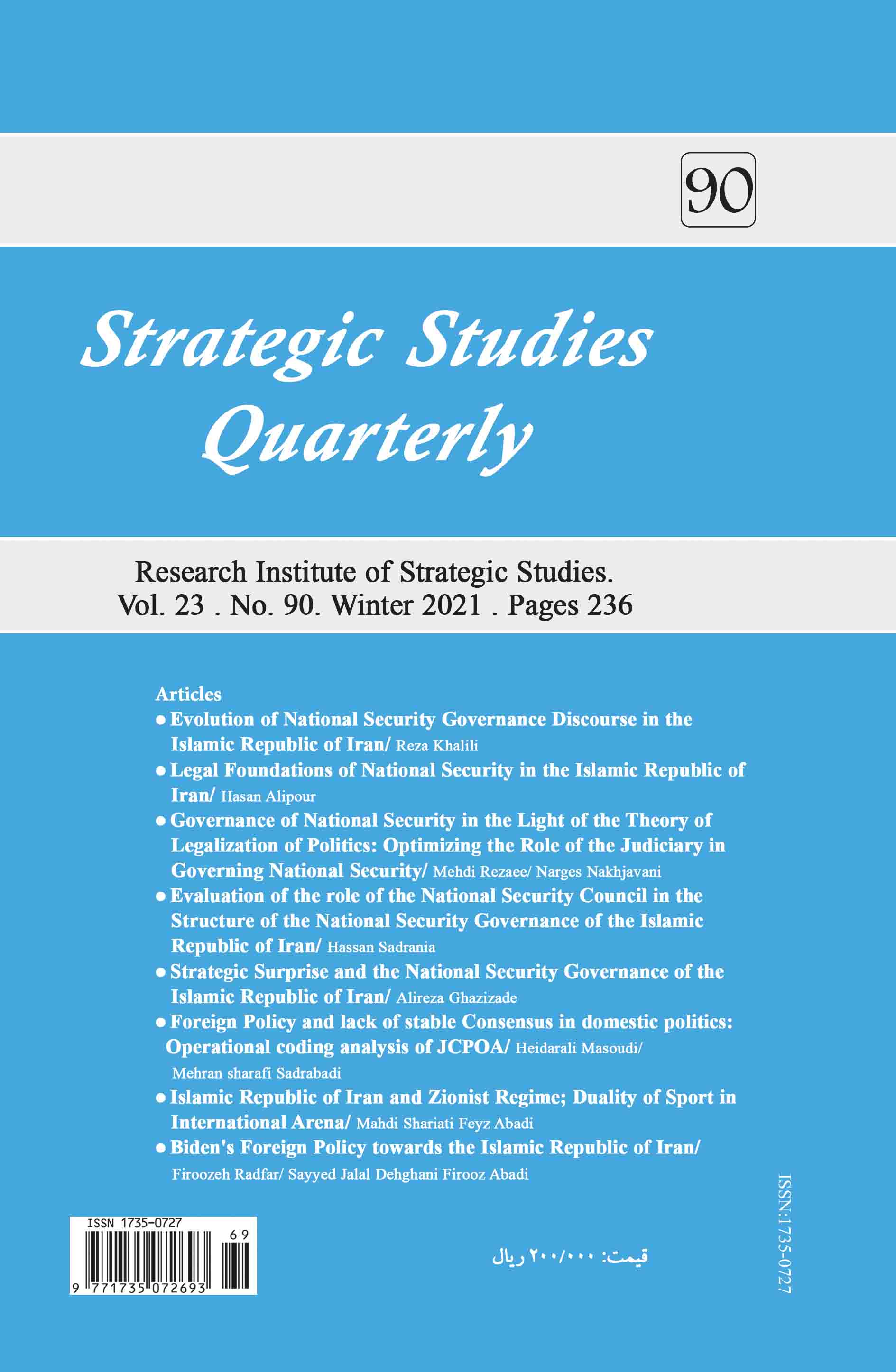
Volume & Issue: Volume 23, Issue 4 - Serial Number 90, Winter 2021, Pages 1-236 
Number of Articles: 8
Evolution of National Security Governance Discourse in the Islamic Republic of Iran

Evolution of National Security Governance Discourse in the Islamic Republic of Iran

Pages 7-48

Reza Khalili

Abstract Although the discourse of the Islamic Revolution had an epistemological
disconnection with the discourse of Pahlavism as "other discourse" and had a
coherence within itself, but over time and in confronting with different epistemological
discourses, it was affected by changes and many sub-discourses were formed, each of
which had a special impact on the governance of national security in Iran. In this
article, focusing on the differences between the sub-discourses formed within the
discourse of the Islamic Revolution, the question has been raised that what are the
effects of these sub-discourses on the national security governance? In response to this
question, using library resources and analysis of existing relevant secondary
documents, while examining developments in the discourse of the Islamic Revolution,
the principles and foundations as well as the effects and consequences of each subdiscourse
on the national security governance in Iran are analyzed. The hypothesis
examined in this article is that the evolution of the discourse of national security
governance in the Islamic Republic of Iran, despite the development of a specific
governance model of the Islamic Republic, weakens consensus and forms polarization
and conflict in society and also national security structures and institutions.

Legal Foundations of National Security in the Islamic Republic of Iran

Legal Foundations of National Security in the Islamic Republic of Iran

Pages 49-80

Hassan Alipour

Abstract This article studies the legal foundations of national security in the Islamic Republic
of Iran by using analytical method and peruses the linkage between national security
and legal system, the place of national security in the legal system and the path
towards the legal system of national security, concludes that the main foundation of
national security in Iran is based on the Constitution, public obligations and
individual rights and liberties. The connection between them protects national
security in a way that not only special authorities or institutions but also everyone is
considered as the guardians of national security. When propounding expediency as a
strong principle in introducing national security in Iran, this field moves away from
the main principle that is based on public presence and finds a fragile position. Apart
from this, Iran's national security, with its internal and external security approach,
continues to be practically within the legal system rather than along it. The proposal
of this article is to legalize national security according to the Constitution, as well as
to focus on moral and religious principles and to adopt an exceptional approach to
the basis of expediency. Thus, national security will gain a well-established place in
the legal system.

Governance of National Security in the Light of the Theory of
Legalization of Politics: Optimizing the Role of the Judiciary in
Governing National Security

Governance of National Security in the Light of the Theory of Legalization of Politics: Optimizing the Role of the Judiciary in Governing National Security

Pages 81-110

Mehdi Rezaee, Narges Nakhjavani

Abstract National security, in modern definitions, in addition to the classical components of
security such as the absence of external threats, is closely interacting with the stability
and survival of the political system and governance and includes components that
focus on citizens, such as civil rights, public trust, political legitimacy and Economic
efficiency. On the other hand, in looking at this concept, the ratio of each of the pillars
of sovereignty should be measured and adjusted with it, and the judiciary is one of the
pillars of sovereignty. Given the main function of the judiciary in establishing justice,
it can be considered the most important element of governance in achieving political
legitimacy, protection of citizens' rights and the efficiency of executive institutions, all
of which lead to the establishment and strengthening of national security. The present
article, by emphasizing this position of the judiciary, examines its performance in
providing national security. Accordingly, the judiciary, on the one hand, will help < br />strengthen national security by providing judicial security, which requires the rule of
law, judicial independence and respect for civil rights, and all of which are modern
requirements of national security. On the other hand, the role of this power in
governing national security has been studied during a phenomenon called policy
judicialization. The connection of the concept of judicial oversight with the executive
and political processes in the world has led to the formation of the phenomenon of
judicial legalization. In the present article, the relationship between the judicialization
of politics and the expansion of the oversight powers of the judiciary to achieve greater
and stronger national security has been examined.

Evaluation of the role of the National Security Council in the Structure
of the National Security Governance of the Islamic Republic of Iran

Evaluation of the role of the National Security Council in the Structure of the National Security Governance of the Islamic Republic of Iran

Pages 111-146

Hassan Sadrania

Abstract In national security governance, security policy-making is the duty of the
government. One of the tools of security management is governmental institutions.
According to the law, the country’s National Security Council is one of the
institutions in charge of national security policy management, which is responsible
for the internal security of the country through the security provision councils and
the relevant commissions in the provinces and cities. The purpose of this article is to
analyze, pathologize and evaluate the role of the National Security Council in the
governance structure of national security; for this purpose, the structural, functional
and legal areas of the Council and its relationship with other councils and
institutions responsible in the field of internal security have been measured. The
results of this article indicate that factors such as shortcomings in the law
determining the duties and organization of the country's security council,
composition of members and the type of their role in the council, reducing the
concept of internal security to military and law enforcement security and duty
overlapping with that of other institutions has caused this council not to be able to
play an effective role in the structure of the country's security governance as it
should; therefore, it has become more of a coordinating institution.

Strategic Surprise and the National Security Governance of the Islamic Republic of Iran

Strategic Surprise and the National Security Governance of the Islamic Republic of Iran

Pages 147-174

Alireza Ghazizade

Abstract Strategic surprise occurs when the national security system is unable to fully prevent
a crisis or of a priori management of the situation to reduce the damages caused by
the crisis. National security governance also means the activism of certain
institutions of the country's political structure that have a specific mission in the
field of national security by law. Accordingly, the main question is what effect does
strategic surprise have on the governance of national security in the Islamic
Republic of Iran? The results of this article show that the occurrence of strategic
surprise postpones the national security decision-making process and increases the
costs of security. While increasing cognitive bias, ambiguity in the role of
threatening actors, keeping national security officials busy, reducing the stability and
influence of national sovereignty, doubts about security priorities, increasing
insignificant signals and increasing public distrust of the national security system are
some examples of the impact of strategic surprise on the national security
governance. This article suggests ways to reduce these surprises.

Foreign Policy and lack of stable Consensus in domestic politics:
Operational coding analysis of JCPOA

Foreign Policy and lack of stable Consensus in domestic politics: Operational coding analysis of JCPOA

Pages 175-224

Heidarali Masoudi, Mehran Sharafi Sadrababi

Abstract Foreign policy is one of the most controversial areas of governance. The complexity,
fluidity, and sensitivity of issues and multiple actors involved make it hard to create
and maintain a stable consensus on foreign policy. Different models of consensusbuilding
have been applied in the different political systems. Concluding a multilateral
or bilateral agreement with other countries can be a starting point for widening the gap
between different political factions. JCPOA as a multilateral agreement between Iran
and the P5 + 1 caused many debates among Iranian political elites, even some years
after its conclusion in 2015. The main question of the article is that whether and to
what extent Iran has been successful in consensus-building in foreign policy. Focusing
on JCPOA's experience and using operational coding analysis, this article analyzes the
perceptual structures of political elites about JCPOA in the pre-and post-US
withdrawal. The operational code analysis of Iran's political elites about JCPOA
showed that there is no appropriate and efficient perceptual structure for creating a
stable consensus on Iran’s foreign policy between the three spectrums of
internationalist, anti-hegemonic, and swing elites.

Islamic Republic of Iran and Zionist Regime; Duality of Sport in
International Arena

Islamic Republic of Iran and Zionist Regime; Duality of Sport in International Arena

Pages 205-224

Mehdi Shariati Feizabadi

Abstract The purpose of this article is to explain the existential threat of Zionist regime's sport
in international arena for Iran. From the perspective of purpose, the findings of this
article are practical and from the perspective of data collection, they are desk review.
They show that the sport of the Islamic Republic of Iran, after more than four decades
of not confronting the representatives of the Zionist regime in various fields, is now
facing an important challenge. According to the increasing investment of this regime
in different sport fields to gain more international prestige and performance, in coming
years, Iranian sport will face many challenges due to the presence of Israeli athletes
especially in Iran's medal-winning arenas such as wrestling, weight-lifting, judo and
etc. So, taking appropriate measures at the present time to deal with this problem can
prevent future crises for Iranian sports. Aligning Muslim countries with its approach
and goals, justifying international sports institutions using the experiences of other
countries, and distinguishing between "playing" and "recognition" are some
suggestions made by the author of this article.

Bidens Foreign Policy towards the Islamic Republic of Iran

Biden's Foreign Policy towards the Islamic Republic of Iran

Pages 225-252

Firoozeh Radfar, Sayyed Jalal Dehghani Firooz Abadi

Abstract Before and after the election, Joe Biden has stated that one of his foreign policy
priorities is to formulate and pursue a new US policy towards Iran. At the heart of
Biden's "Iranian politics" is his return to JCPOA. However, there are ambiguities about
nature and quality of this policy and also USA return to JCPOA. Therefore, this article
tries to answer this question: What are the nature, components and coordinates of
Biden's foreign policy towards Iran and what will it be like? By documentary study
method and analyzing the speeches, letters, and statements made by Biden and his
foreign policy team, it is argued that Biden's foreign policy discourse is "liberal
internationalism." His nuclear policy is also based on a thematic and step-by-step link
to return to the JCPOA in the first step, strengthen and expand its provisions and
extend its time in the second step, and finally extend it to the missile program and
Iran's regional influence in the third step.